
Best APIs to Use with Cursor for AI Workflows适合 Cursor AI 工作流的最佳 API
Compare practical APIs for Cursor workflows by data fit, freshness, permissions, latency, and production controls.
从数据匹配度、时效、权限、延迟和生产控制等方面,对比适合 Cursor 工作流的实用 API。
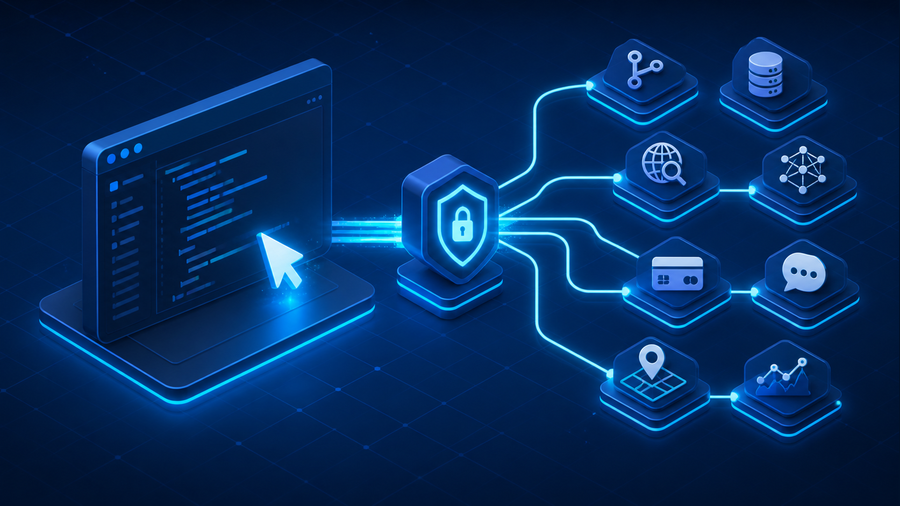
How we chose the best APIs for Cursor
This is a workflow shortlist, not a claim that one vendor is universally superior. Each category adds something repository context cannot provide: current evidence, external state, or a controlled action. We favored documented interfaces, structured responses, testability, scoped authentication, and clear failure behavior.
Cursor officially supports external tools through Model Context Protocol servers. MCP can adapt REST, GraphQL, or vendor SDKs into typed agent tools, but it does not replace credential protection, argument validation, result limits, or approval for consequential writes.
The 8 best API categories to use with Cursor
QVeris API & MCP
Best for unified tool discoveryUse QVeris when a workflow must discover and call multiple external tools without a bespoke adapter for every provider. The QVeris documentation explains search and execution, while the tool directory narrows broad provider capabilities into specific operations.
GitHub REST & GraphQL APIs
Best for software deliveryGitHub is the natural choice for issue context, pull-request metadata, checks, releases, and repository automation. The official REST API provides task-oriented endpoints. Start read-only; creating an issue or draft pull request is easier to review than merging code or changing branch protection.
Supabase Data API
Best for application dataSupabase gives Cursor a clear route from schema to a Postgres-backed application. Its Data API documentation covers generated REST and GraphQL interfaces. Use Row Level Security, separate service credentials from client keys, and review destructive migrations before execution.
Tavily Search API
Best for current researchChoose Tavily when Cursor needs focused web retrieval with source URLs for current documentation, recent comparisons, or a research feature. Its official Search API reference documents query controls and response fields. Treat generated summaries as leads: open the primary sources, retain relevant dates, and cite the page that actually supports the conclusion.
Slack Web API
Best for human-in-the-loop collaborationSlack can turn a code-side workflow into a reviewable team process: fetch a thread, draft a deployment summary, or request approval. The Web API documentation defines methods and scopes. Use the smallest bot scopes and preview generated messages before sending.
Stripe API
Best for payment workflowsStripe is useful for checkout, subscriptions, and webhook-driven billing state. Follow the official API reference, use test mode, verify webhook signatures, and make handlers idempotent. Keep payment creation and refunds behind explicit approval.
Google Maps Platform APIs
Best for location-aware appsUse Maps APIs for geocoding, place lookup, routes, or travel-time estimates. Build a typed adapter around the official Maps Platform documentation. Restrict keys by application and API, respect attribution and storage rules, and handle ambiguous addresses.
Sentry API
Best for production diagnosisA read-only Sentry integration can give Cursor issue details, stack traces, release context, and event samples through the Sentry API. Redact sensitive event data and do not treat one trace as proof of root cause. Add a regression test before resolving the issue.
Useful API combinations for real Cursor projects
The strongest workflow is rarely “connect every API.” It is a small chain in which each service owns one kind of evidence or action. Keep the chain observable: every tool result should identify its source, timestamp, request scope, and failure state. Cursor can then reason over bounded results without becoming the place where credentials, retries, and business rules live.
Research a change, implement it, and open a draft PR
Combine a search API with GitHub when Cursor needs current documentation before changing code. Search should return a short list of canonical sources; Cursor opens the primary documentation, records the version or date when relevant, implements the smallest change, runs the repository checks, and creates a draft pull request. Do not allow search snippets alone to justify an API signature, and do not grant merge permission merely because the code compiles.
Build a feature against real application data
Combine Supabase with GitHub for schema-aware feature work. Start with schema inspection and read-only sample rows, then generate fixtures that contain no production personal data. Database migrations should be reviewed as artifacts in the pull request, with destructive statements and policy changes called out explicitly. Cursor should not receive a service-role key in its prompt or repository; the MCP server or application backend should hold credentials and expose narrow operations.
Diagnose an incident and prepare a team update
Combine Sentry with Slack when the task is to investigate a production error and communicate status. Sentry supplies a bounded event sample, release context, and stack trace; repository tools map the trace to code; Slack receives a draft summary only after sensitive fields are redacted. Treat the proposed root cause as a hypothesis until a regression test reproduces the failure. Sending the message, resolving the issue, or starting a deployment should remain separate, reviewable actions.
Prototype monetization without exposing live payment authority
Combine Stripe test mode with a database API to build checkout, subscription, and webhook flows. Use synthetic customers, signed test webhooks, idempotent handlers, and an explicit state model for retries. Cursor can generate and test the integration, but live charges, refunds, and entitlement changes deserve restricted keys and human approval. This boundary lets the coding workflow stay fast without turning a generated tool call into an irreversible business event.
Evaluate the tool contract before the API brand
An API may have excellent documentation and still be a poor agent tool if one call can return thousands of rows, trigger an irreversible action, or hide which account it affects. Before connecting it to Cursor, define the contract that sits between the coding agent and the provider.
Scope, freshness, and result limits
Write down the allowed resources, date range, page size, maximum calls, timeout, retry policy, and required freshness. A “get recent errors” tool is safer and easier to test than a generic “run any Sentry query” tool. A stock quote, deployment status, and billing record also have different freshness expectations; return timestamps rather than letting the model guess.
Authentication and environment boundaries
Use separate credentials for local development, CI, staging, and production. Prefer short-lived or restricted tokens where the provider supports them, and keep secrets outside prompts, generated source files, logs, and tool results. The response should identify the environment and account in a non-sensitive form so a reviewer can catch accidental production access.
Approval, provenance, and failure behavior
Read operations can often run automatically, while messages, payments, deletes, merges, and permission changes should pause for confirmation. Return typed errors for authentication failure, rate limits, timeouts, partial data, and policy rejection. Preserve the provider request ID or equivalent provenance when available. These details make a Cursor workflow debuggable and prevent a fluent explanation from hiding an incomplete API response.
Choose by the missing capability
| Need | Start with | First operation | Guardrail |
|---|---|---|---|
| Discover tools | QVeris | One read operation | Schema and result caps |
| Ship code | GitHub | Issue and PR metadata | No automatic merge |
| Store app state | Supabase | SELECT and fixtures | RLS |
| Research the web | Tavily | Search with source URLs | Open and verify primary sources |
| Add location context | Google Maps | Geocode one address | Key restrictions and ambiguity checks |
| Coordinate people | Slack | Draft a message | Preview before sending |
| Monetize | Stripe | Test checkout | Signed webhooks |
| Diagnose production | Sentry | Read-only issue context | Redaction and tests |
A production-shaped integration pattern
Define one bounded job
Specify the input, output, freshness requirement, maximum result size, and whether the operation reads or writes.
Wrap the API as a typed tool
Keep credentials server-side, validate arguments, normalize errors, and return timestamps and provenance.
Connect through MCP
Register only the operations the workflow needs and configure Cursor permissions at the narrowest useful scope.
Test failure states
Cover empty results, invalid auth, rate limits, timeouts, partial responses, duplicate webhooks, and revoked permissions.
Controls that matter more than the API brand
- Use separate credentials for development, testing, and production.
- Default to read-only scopes and add write permissions one operation at a time.
- Require confirmation for messages, payments, deletions, merges, and access changes.
- Cap pages, rows, date ranges, payload size, retries, and total calls.
- Treat every API response as untrusted input and validate it before acting.
For a focused live-data example, read about real-time stock market data for Cursor.
Frequently asked questions
Can Cursor call APIs directly?
Cursor supports external tools through MCP. A small MCP server can hold credentials, call a REST or GraphQL API, validate the response, and return a bounded result.
Which API should I connect first?
Choose the API that supplies the one piece of external evidence or state blocking your workflow.
Should I give Cursor a raw API key?
No. Keep credentials in the tool server environment or an approved secret manager, and expose only narrow operations.
Is REST or MCP better for Cursor?
They solve different layers. REST is commonly the provider interface; MCP describes tools to the agent and carries tool calls.
Give Cursor one dependable tool before giving it eight
Test one exact operation with bounded inputs, inspect its response, and only then connect it to automation.