
Best APIs to Use with WorkBuddy for AI Workflows适合 WorkBuddy AI 工作流的最佳 API
Compare practical APIs for WorkBuddy workflows by data fit, freshness, permissions, latency, and production controls.
从数据匹配度、时效、权限、延迟和生产控制等方面,对比适合 WorkBuddy 工作流的实用 API。
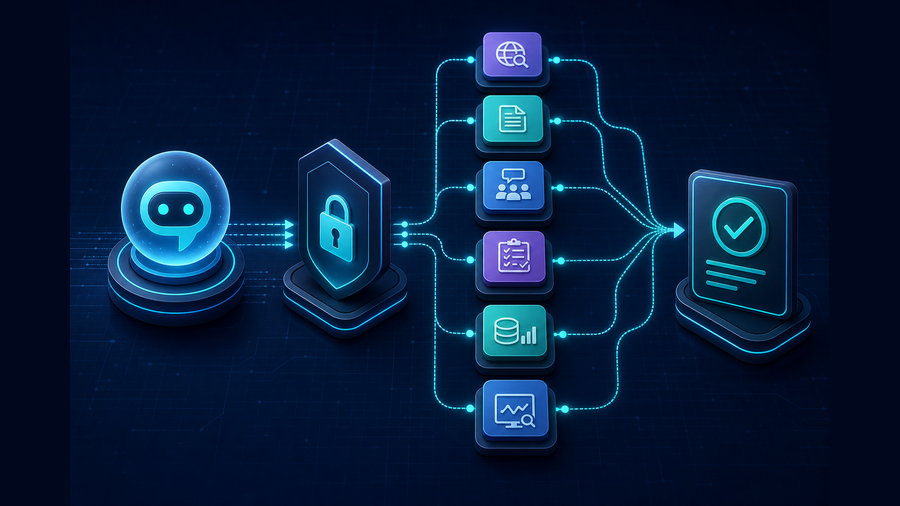
How we chose APIs for WorkBuddy
This is a use-case ranking, not a universal vendor benchmark. WorkBuddy already organizes agent capabilities and workflows; an external API is valuable only when it closes a concrete gap: fresh information, authoritative business state, or a controlled external action. We prioritized structured responses, explicit authentication, narrow resource scopes, stable documentation, testable failures, and useful read-only modes.
The official WorkBuddy handbook documents capabilities, workflows, agent documentation, and activity summaries through its MCP gateway. That makes API selection a governance question as much as a compatibility question. A callable tool still needs credential isolation, input validation, result limits, human approval for consequential writes, and an observable outcome.
The 6 best APIs to use with WorkBuddy
QVeris API & MCP
Best for cross-provider tool discoveryUse QVeris when WorkBuddy needs several live data capabilities but you do not want a separate adapter for every provider. The practical pattern is discover, inspect, then call: find a relevant operation, review its parameters and source, and execute only after the input is bounded. This fits research, enrichment, market monitoring, location, and other evidence-led tasks.
Google Workspace APIs
Best for document-centered operationsDrive, Docs, Sheets, and Calendar APIs can give WorkBuddy structured access to the material where teams plan and report. Strong workflows include summarizing a named folder, extracting decisions from a document set, preparing a meeting brief, or writing an approved table into a designated sheet. Use separate OAuth scopes and resource allowlists rather than broad account access.
Slack Web API
Best for team communicationSlack is useful when the workflow begins or ends with a team conversation: collect messages from approved channels, produce a cited digest, draft a response, or post an approved status update. Read and write are different trust classes. Keep posting behind confirmation, avoid private-message access unless essential, and include source permalinks in summaries.
Linear GraphQL API
Best for structured task workflowsLinear turns project state into typed issues, projects, cycles, and comments. WorkBuddy can summarize overdue work, connect meeting decisions to existing issues, prepare a triage queue, or create a draft issue after approval. Search before creation to avoid duplicates, preserve the original requester and evidence, and constrain writes to named teams.
Airtable Web API
Best for lightweight operational dataAirtable suits teams whose operational source of truth is a structured base rather than a full application database. WorkBuddy can retrieve records with formulas, prepare weekly rollups, identify incomplete entries, and propose normalized updates. Lock the integration to named bases and tables, validate field types, paginate results, and treat attachments as separate untrusted inputs.
Sentry API
Best for workflow observabilitySentry helps when WorkBuddy supports engineering or business processes that must distinguish a completed call from a successful outcome. The API can retrieve issues, events, releases, and project health for diagnosis and reporting. Start with read-only projects, redact personal data, and link every generated conclusion to the underlying event or issue.
Three useful WorkBuddy workflow recipes
| Outcome | API stack | Human checkpoint |
|---|---|---|
| Weekly market brief | QVeris + Google Docs | Approve sources and final narrative |
| Meeting-to-execution | Google Docs + Linear + Slack | Confirm owners and issue creation |
| Incident digest | Sentry + Slack + Linear | Approve external update and remediation tasks |
Why combinations beat one “universal” API
A dependable workflow separates evidence, state, action, and notification. For example, QVeris may collect current evidence, Google Docs holds the approved narrative, Linear tracks the work, and Slack communicates the result. Each boundary can use a different credential and approval rule. This is easier to audit than giving one connector broad access to everything.
A safe rollout pattern for WorkBuddy APIs
1. Define one outcome
Write the expected input, output, source of truth, and success evidence before choosing an API.
2. Start read-only
Grant only named resources and operations. Keep secrets outside prompts and shared workflow text.
3. Test negative paths
Exercise expired credentials, rate limits, empty results, partial data, timeouts, and denied actions.
4. Verify the outcome
Do not treat HTTP success as task success. Confirm the record, message, or artifact exists as intended.
Decision checklist
- Does the API close a repeated capability gap rather than duplicate existing WorkBuddy context?
- Can authentication be limited by operation, resource, team, workspace, or project?
- Are responses structured, bounded, attributable, and independently verifiable?
- Can reads and writes use separate credentials and approval policies?
- Is there a timeout, retry, deduplication, rate-limit, and disable strategy?
- Will logs capture tool identity, arguments, decision, result status, and latency without unnecessary personal data?
Frequently asked questions
What is the best API to add to WorkBuddy first?
Start with the narrowest API that closes a repeated information gap. QVeris is a strong first layer when you need multiple current data capabilities; Google Workspace is more appropriate when the source of truth is already in team documents.
Does WorkBuddy support MCP tools?
WorkBuddy's official handbook documents capabilities and workflows exposed through its MCP gateway. Exact availability depends on the installed version and configuration, so verify the current handbook and inspect the exposed tool surface before granting access.
How many APIs should a WorkBuddy workflow use?
There is no fixed number. Two or three specialized APIs are often enough for one outcome. The stack is too broad when tools overlap, routing becomes unreliable, permissions are hard to explain, or failure diagnosis requires checking many unrelated systems.
Should WorkBuddy be allowed to write through APIs automatically?
Only for narrow, reversible, well-tested actions with clear deduplication. Publishing, deletion, payments, identity changes, external messages, and production changes should retain explicit approval and post-action verification.
Build a smaller, verifiable WorkBuddy stack
Choose one missing capability, inspect the tool contract, test with representative data, and expand only after the whole outcome is observable.