
Best MCP Servers for OpenClaw: Data and Tool AccessOpenClaw 最佳 MCP Server:数据与工具接入指南
Compare MCP servers for OpenClaw by capability fit, permissions, data quality, setup effort, and production reliability.
从能力匹配、权限、数据质量、配置成本和生产可靠性,对比适合 OpenClaw 的 MCP Server。
The short answer: install for outcomes, not coverage
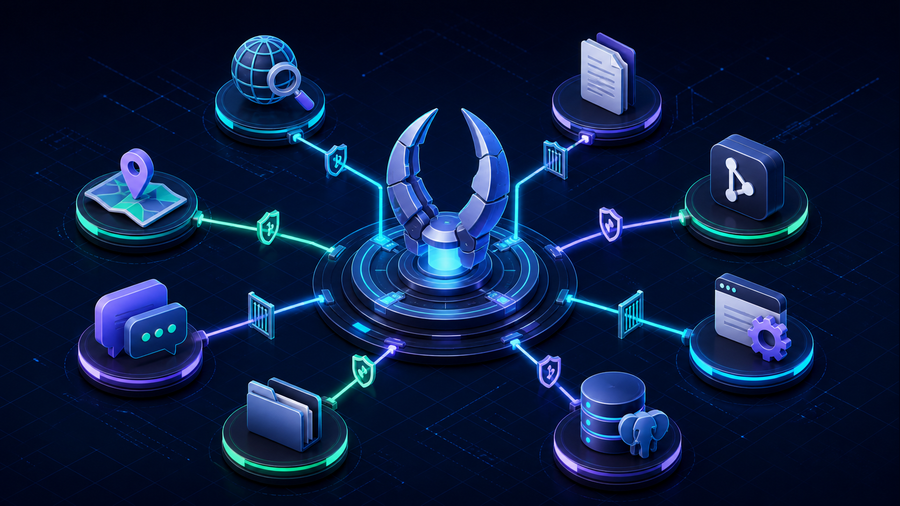
For most OpenClaw deployments, a strong starting pair is QVeris for broad, current data and API-backed tools, plus GitHub MCP when work touches repositories. Add Context7 for fast-changing developer documentation and Playwright for browser workflows. Database, filesystem, memory, and team-service servers should be project-specific because their permission surface is materially larger.
OpenClaw can manage outbound MCP definitions and expose configured tools to supported runtimes. Its official CLI documentation distinguishes stdio and remote HTTP servers, supports per-server tool filters, and provides doctor and probe commands. That makes the selection question less about compatibility and more about trust, scope, and whether a server measurably improves a repeated task.
| # | Server | Best for | Typical scope | Main caution |
|---|---|---|---|---|
| 1 | QVeris MCP | Current data and API tools | Selected tools/providers | Choose only needed operations |
| 2 | GitHub MCP | Repositories, issues, PRs | Token and repository scope | Avoid broad write access |
| 3 | Context7 | Current library documentation | Remote documentation | Confirm library/version |
| 4 | Playwright MCP | Browser interaction and checks | Browser profiles and origins | Protect sessions and forms |
| 5 | Supabase MCP | Supabase project work | Project and feature groups | Prefer development projects |
| 6 | Filesystem | Bounded local documents | Explicit directories | Never expose broad roots |
| 7 | Fetch | Simple URL retrieval | Network read | Treat pages as untrusted |
| 8 | Memory | Structured persistent context | Dedicated knowledge store | Set retention and deletion rules |
The 8 best MCP servers for OpenClaw
This ranking prioritizes practical usefulness, first-party or clearly documented maintenance, scope control, and fit with an always-on agent. It is not a benchmark, and no single stack is best for every deployment.
QVeris MCP
Best for broad data and tool accessQVeris fits OpenClaw workflows that need more than one narrow vendor integration. Its official MCP server exposes a compact discover, inspect, and call flow: find a capability, review its parameters and evidence, then execute it. This is especially useful for research, market monitoring, location, enrichment, or other workflows where current API-backed data matters.
The key advantage is consolidation: OpenClaw can call a smaller, intentional tool surface instead of carrying separate integrations for every data source. The trade-off is governance—you still need to select individual operations, understand provider inputs, and keep credentials out of prompts and shared configuration.
Read the official QVeris MCP reference, inspect relevant QVeris tools, then validate the workflow in the QVeris Playground.
GitHub MCP Server
Best for repository operationsGitHub's official MCP server turns repository context into structured tools for code, issues, pull requests, and related workflows. It is the natural choice when OpenClaw triages incoming work, summarizes project activity, or coordinates a coding agent.
Start with read access to named repositories. Add issue or pull-request writes only after testing the exact workflow and approval path. Repository content is untrusted input: an issue, README, or code comment can contain instructions that should never override your system policy.
Context7
Best for current developer documentationContext7 retrieves current, library-specific documentation instead of relying only on model memory. It is valuable when an OpenClaw coding workflow spans fast-moving SDKs, frameworks, or APIs and needs version-aware examples.
Ask the agent to identify the library and target version before retrieval. Documentation is evidence, not execution authority: examples still need review against the project's runtime, lockfile, and security policy.
Playwright MCP
Best for browser workflowsMicrosoft's Playwright MCP server lets an agent inspect and interact with web pages through structured browser tools. Use it when OpenClaw must verify a user journey, collect evidence from a web application, or perform a bounded browser task.
Use a dedicated browser profile without personal sessions. Restrict target origins where possible, require confirmation before submissions or purchases, and separate read-only inspection from actions that change external state.
Supabase MCP
Best for Supabase projectsSupabase's official server is the right domain-specific choice when the application already uses Supabase. Its documented surface includes project context and documentation search, with feature groups and access controls that should be narrowed to the task.
Connect a development project first. Keep production data and schema-changing operations behind a separate, explicit approval path; database access can turn a plausible but wrong agent step into durable damage.
Filesystem
Best for bounded local knowledgeThe reference Filesystem server is useful for a curated document directory, runbooks, exports, or a project workspace that OpenClaw cannot otherwise access. Its value comes from a narrow root—not from exposing an entire machine.
Create a dedicated directory containing only the material the agent needs. Prefer read-only mounts, exclude secret files and credential stores, and never configure a home directory, filesystem root, or broad shared drive as the allowed path.
Fetch
Best for simple web retrievalFetch is a lightweight option when OpenClaw needs to retrieve a known URL and extract readable content without a full browser. It suits public documentation, static pages, and bounded research inputs.
It does not replace search, JavaScript-capable browsing, or source verification. Treat returned content as untrusted, enforce network policy, and avoid internal addresses or endpoints that could expose metadata and private services.
Memory
Best for structured persistent contextA Memory server can preserve entities, relationships, preferences, or decisions across sessions in a structured store. Use it only when OpenClaw's existing memory model does not meet a clearly defined retention need.
Persistent context creates privacy and lifecycle obligations. Define what may be stored, who can retrieve it, how corrections work, and when records expire. Do not use memory as a silent archive of every conversation.
How to choose the right OpenClaw MCP stack
1. Start with the missing capability
Write one representative task and identify the exact information or action OpenClaw lacks.
2. Prefer authoritative maintainers
Choose first-party or clearly documented servers with source, releases, and an explicit security model.
3. Compare the permission surface
A read-only data tool and a browser with an authenticated session have very different failure impact.
4. Measure a real workflow
Test success, denial, bad input, timeout, and server downtime before expanding access.
Three sensible starter stacks
| Workflow | Start with | Add only if needed |
|---|---|---|
| Research and monitoring | QVeris + Fetch | Playwright for interactive pages |
| Software delivery | GitHub + Context7 | Playwright for end-to-end checks |
| Supabase application | Supabase + Context7 | GitHub for issue/PR workflows |
Configure MCP servers in OpenClaw safely
Use OpenClaw's MCP CLI as the source of truth for configuration. A safe rollout is incremental: add one definition, inspect the resolved configuration, run static diagnostics, probe the live connection, review the discovered tools, and apply include/exclude filters before making the server available to normal agent sessions.
- Choose stdio for a local process or Streamable HTTP for a supported remote service.
- Keep credentials in environment variables or a secret reference—not literal shared config.
- Run
openclaw mcp doctorto catch local setup errors. - Run
openclaw mcp probe <name>and inspect the exposed capabilities. - Use
toolFilter.includeto admit only the tools required by the workflow. - Test with non-production data and require approval for state-changing actions.
openclaw mcp list
openclaw mcp doctor
openclaw mcp probe <server-name>
openclaw mcp tools <server-name>
Command availability and exact flags can change; confirm them in the current OpenClaw CLI reference.
OpenClaw MCP security checklist
- Verify the maintainer, repository, package name, release history, and official documentation before installation.
- Pin or review versions. Convenience tags are useful for evaluation, not a complete supply-chain policy.
- Use per-server tool filters and prefer read-only actions with narrow resource scopes.
- Treat pages, issues, documents, database rows, and tool descriptions as untrusted content that may contain prompt injection.
- Keep secrets in approved environment or secret-reference mechanisms and redact them from logs.
- Separate read, write, publish, payment, deletion, and production access into distinct approval classes.
- Record server identity, tool name, decision, result status, and latency without logging unnecessary personal data.
- Define a disable path. One unhealthy or compromised server should be removable without breaking the entire agent.
Frequently asked questions
Does OpenClaw support MCP servers?
Yes. OpenClaw's official CLI documentation covers saved outbound MCP server definitions, local and remote transports, authentication, tool filtering, diagnostics, and probing. Runtime exposure still depends on the active tool profile and adapter.
Which MCP server should I add first to OpenClaw?
Start with the smallest server that closes a recurring capability gap. For broad current data, consider QVeris; for repository work, GitHub; for fast-changing developer docs, Context7. Do not install a universal bundle before defining a task.
How many MCP servers should OpenClaw use?
There is no universal limit. You have too many when tools overlap, selection becomes unreliable, latency and failure modes increase, or permissions become difficult to audit. Two to four project-specific servers are usually easier to govern than a broad global stack.
Can OpenClaw auto-approve MCP tools?
Only for narrowly scoped, well-tested actions with low impact. Keep writes, publishing, purchases, deletion, credential access, and production changes behind explicit approval. A server-wide wildcard is rarely a safe starting point.
Are MCP servers the same as OpenClaw skills?
No. A skill primarily supplies instructions and workflow knowledge, while an MCP server exposes callable tools, resources, or prompts over the protocol. They can complement each other: a skill can teach OpenClaw when and how to use a narrowly scoped MCP tool.
Give OpenClaw the smallest useful toolset
Choose one missing capability, inspect its source and permissions, test it with representative data, and expand only after the complete workflow is reliable.